Wednesday, May 29, 2013

The Lubbock Lights


The Lubbock Lights were an unusual formation of lights seen over the city of Lubbock, Texas from August–September 1951. The Lubbock Lights incident received national publicity and is regarded as one of the first great UFO cases in the United States.
Carl Hart Jr.

The first publicized sighting of the lights occurred on August 25, 1951, at around 9 pm. Three professors from Texas Technological College (now Texas Tech University), located in Lubbock, were sitting in the backyard of one of the professor's homes when they observed the "lights" fly overhead. A total of 20-30 lights, as bright as stars but larger in size, flew over the yard in a matter of seconds. The professors immediately ruled out meteors as a possible cause for the sightings, and as they discussed their sighting a second, similar, group of lights flew overhead.

The three professors - Dr. A.G. Oberg, chemical engineer, Dr. W.L. Ducker, a department head and petroleum engineer, and Dr. W.I. Robinson, a geologist - reported their sighting to the local newspaper, the Lubbock Avalanche-Journal. Following the newspaper's article, three women in Lubbock reported that they had observed "peculiar flashing lights" in the sky on the same night of the professor's sightings. Dr. Carl Hemminger, a professor of German at Texas Tech, also reported seeing the objects, as did the head of the college's journalism department.

The three professors became determined to view the objects again and perhaps discover their identity. On September 5, 1951, all three men, along with two other professors from Texas Tech, were sitting in Dr. Robinson's frontyard when the lights flew overhead. According to Dr. Grayson Mead the lights "appeared to be about the size of a dinner plate and they were greenish-blue, slightly fluorescent in color. They were smaller than the full moon at the horizon. There were about a dozen to fifteen of these lights...they were absolutely circular...it gave all of us...an extremely eerie feeling." Mead claimed that the lights could not have been birds, but he also stated that they "went over so fast...that we wished we could have had a better look." The professors observed one formation of lights flying above a thin cloud at about 2,000 feet (610 m); this allowed them to calculate that the lights were traveling at over 600 miles per hour (970 km/h).

The Hart photographs
Lubbock Lights, 1.

On the evening of August 30, 1951, Carl Hart, Jr., a freshman at Texas Tech, was lying in bed looking out of the window of his room when he observed a group of 18-20 white lights in a "v" formation flying overhead. Hart took a 35-mm Kodak camera and walked to the backyard of his parent's home to see if the lights would return. Two more flights passed overhead, and Hart was able to take a total of five photos before they disappeared.  After having the photos developed Hart took them to the offices of the Lubbock Avalanche-Journal. After examining the photos the newspaper's editor, Jay Harris, told Hart that he would print them in the paper, but that he would "run him (Hart) out of town" if the photos were fake. When Hart assured him that the photos were genuine, Harris paid Hart $10 for the pictures. The photographs were soon reprinted in newspapers around the nation, and were printed in LIFE magazine, thus giving them wide publicity. The physics laboratory at Wright-Patterson Air Force Base in Ohio analyzed the Hart photographs. After an extensive analysis and investigation of the photos, Lieutenant Edward J. Ruppelt, the supervisor of the Air Force's Project Blue Book, released a written statement to the press that "the [Hart] photos were never proven to be hoax, but neither were they proven to be genuine."  Hart has consistently maintained to this day that the photos are genuine. Curiously, the Texas Tech professors claimed that the photos did not represent what they had seen, since their objects had flown in a "u" formation instead of the "v" formation depicted in Hart's photos.

Air Force investigation and controversy

In late September 1951, Lieutenant Ruppelt read about the Lubbock Lights and decided to investigate them.  Project Blue Book, founded in 1948 as Project Sign, was the Air Force's official research group assigned to investigate UFO reports. Ruppelt traveled to Lubbock and interviewed the professors, Carl Hart, and others who claimed to have witnessed the lights. Ruppelt's conclusion at the time was that the professors had seen a type of bird called a plover. The city of Lubbock had installed new vapor street lights in 1951, and Ruppelt believed that the plovers, flying over Lubbock in their annual migration, were reflecting the new street lights at night. Witnesses who supported this assertion were T.E. Snider, a local farmer who on August 31, 1951 had observed some birds flying over a drive-in movie theater; the bird's undersides were reflected in the light. Another witness, Joe Bryant, had been sitting outside his home with his wife on August 25 - the same night on which the three professors had first seen the lights. According to Bryant, he and his wife had seen a group of lights fly overhead, and then two other flights. Like the professors, they were at first baffled by the objects, but when the third group of lights passed overhead they began to circle the Bryant's home. Mr. Bryant and his wife then noticed that the lights were actually plovers, and could hear them as well. In addition, Dr. J. Allen Hynek, an astronomer and one of Project Blue Book's scientific consultants, contacted one of the Texas Tech professors in 1959 and learned that the professor, after careful research, had concluded that he had actually been observing the plovers.

However, not everyone agreed with this explanation. William Hams, the chief photographer for the Lubbock Avalanche-Journal, took several nighttime photos of birds flying over Lubbock's vapor street lights and found that he could not duplicate Hart's photos - the images were too dim to be developed. Dr. J.C. Cross, the head of Texas Tech's biology department, ruled out the possibility that birds could have caused the sightings. A game warden Ruppelt interviewed felt that the sightings could not have been caused by plovers, due to their slow speed (50 mph or 80 km/h) and tendency to fly in groups much smaller than the number of objects reported by eyewitnesses. The warden did admit that an unusually large number of plovers had been seen in the fall of 1951. Dr. Mead, who had observed the lights, strongly disputed the plover explanation: "these objects were too large for any bird...I have had enough experience hunting and I don't know of any bird that could go this fast we would not be able to hear...to have gone as fast as this, to be birds, they would have to have been exceedingly low to disappear quite so quickly. Curiously, in his bestselling 1956 book The Report on Unidentified Flying Objects, Ruppelt himself would come to reject the plover hypothesis, but frustratingly refrained from explaining what the lights in fact were:

"They weren't birds, they weren't refracted light, but they weren't spaceships. The lights ... have been positively identified as a very commonplace and easily explainable natural phenomenon. It is very unfortunate that I can't divulge ... the way the answer was found.... Telling the story would lead to [the identity of the scientist who "finally hit upon the answer"] and ... I promised the man complete anonymity."

The flying wing

While investigating the Lubbock Lights, Ruppelt also learned that several people in and around Lubbock claimed to have seen a "flying wing" moving over the city. Among the witnesses was the wife of Dr. Ducker, who reported that in August 1951 she had observed a "huge, soundless flying wing" pass over her house.  Ruppelt knew that the US Air Force did possess a "flying wing" jet bomber, and he felt that at least some of the sightings had been caused by the bomber, although he could not explain why, according to the witnesses, the wing made no sound as it flew overhead.


Friday, May 24, 2013

The Swedish Ghost Rockets


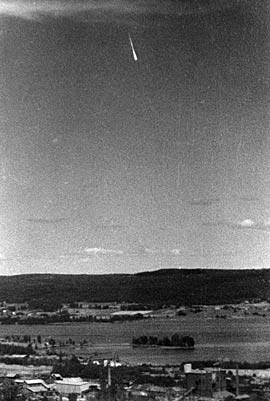
Ghost rockets were rocket-shaped unidentified flying objects sighted in 1946, mostly in Sweden and nearby countries.

The first reports of ghost rockets were made on February 26, 1946, by Finnish observers. About 2,000 sightings were logged between May and December 1946, with peaks on 9 and 11 August 1946. Two hundred sightings were verified with radar returns, and authorities recovered physical fragments which were attributed to ghost rockets.

 File:Ghostrocket 7-09-1946.jpg


Investigations concluded that many ghost rocket sightings were probably caused by meteors. For example, the peaks of the sightings, on the 9 and 11 August 1946, also fall within the peak of the annual Perseid meteor shower. However, most ghost rocket sightings did not occur during meteor shower activity, and furthermore displayed characteristics inconsistent with meteors, such as reported maneuverability.

Debate continues as to the origins of the unidentified ghost rockets. In 1946, however, it was thought likely that they originated from the former German rocket facility at Peenemünde, and were long-range tests by the Russians of captured German V-1 or V-2 missiles, or perhaps another early form of cruise missile because of the ways they were sometimes seen to maneuver. This prompted the Swedish Army to issue a directive stating that newspapers were not to report the exact location of ghost rocket sightings, or any information regarding the direction or speed of the object. This information, they reasoned, was vital for evaluation purposes to the nation or nations performing the tests. However, some investigators for the Swedish military apparently believed the objects could not be conventionally explained, and instead hypothesized an extraterrestrial origin.

Descriptions and early investigations             
The early Russian origins theory was rejected by Swedish, British, and U.S. military investigators because no recognizable rocket fragments were ever found, and according to some sightings the objects usually left no exhaust trail, some moved too slowly and usually flew horizontally, they sometimes traveled and maneuvered in formation, and they were usually silent.
The sightings most often consisted of fast-flying rocket- or missile- shaped objects, with or without wings, visible for mere seconds. Instances of slower moving cigar shaped objects are also known. A hissing or rumbling sound was sometimes reported.
Crashes were not uncommon, almost always in lakes. Reports were made of objects crashing into a lake, then propelling themselves across the surface before sinking, as well as ordinary crashes. The Swedish military performed several dives in the affected lakes shortly after the crashes, but found nothing other than occasional craters in the lake bottom or torn off aquatic plants.
Swedish Air Force officer Karl-Gösta Bartoll searching for "ghost rocket" seen to crash into Lake Kölmjärv on July 19, 1946.

The best known of these crashes occurred on July 19, 1946, into Lake Kölmjärv, Sweden. Witnesses reported a gray, rocket-shaped object with wings crashing in the lake. One witness interviewed heard a thunderclap, possibly the object exploding. However, a 3 week military search conducted in intense secrecy again turned up nothing.

Immediately after the investigation, the Swedish Air Force officer who led the search, Karl-Gösta Bartoll (photo right), submitted a report in which he stated that the bottom of the lake had been disturbed but nothing found and that "there are many indications that the Kölmjärv object disintegrated itself...the object was probably manufactured in a lightweight material, possibly a kind of magnesium alloy that would disintegrate easily, and not give indications on our instruments". When Bartoll was later interviewed in 1984 by Swedish researcher Clas Svahn, he again said their investigation suggested the object largely disintegrated in flight and insisted that "what people saw were real, physical objects".
On October 10, 1946, the Swedish Defense Staff publicly stated, "Most observations are vague and must be treated very skeptically. In some cases, however, clear, unambiguous observations have been made that cannot be explained as natural phenomena, Swedish aircraft, or imagination on the part of the observer. Echo, radar, and other equipment registered readings but gave no clue as to the nature of the objects". It was also stated that fragments alleged to have come from the missiles were nothing more than ordinary coke or slag.
On December 3, 1946, a memo was drafted for the Swedish Ghost Rocket committee stating "nearly one hundred impacts have been reported and thirty pieces of debris have been received and examined by FOA" (later said to be meteorite fragments). Of the nearly 1000 reports that had been received by the Swedish Defense Staff to November 29, 225 were considered observations of "real physical objects" and every one had been seen in broad daylight.
U.S. involvement
In early August 1946 Swedish Lt. Lennart Neckman of the Defense Staff's Air Defense Division saw something that was "without a doubt ... a rocket projectile". On August 14, 1946, the New York Times reported that Undersecretary of State Dean Acheson was "very much interested" in the ghost rocket reports, so was U.S. Army Air Force intelligence as indicated nonpublicly by later documents . Then on August 20, the Times reported that two U.S. experts on aerial warfare, aviation legend General Jimmy Doolittle and General David Sarnoff, president of RCA, arrived in Stockholm, ostensibly on private business and independently of each other. The official explanation was that Doolittle, who was now vice-president of the Shell Oil Company, was inspecting Shell branch offices in Europe, while Sarnoff, a former member of General Dwight D. Eisenhower's London staff, was studying the market for radio equipment. However, the Times story indicated that the Chief of the Swedish Defense Staff, made no secret that he "was extremely interested in asking the two generals advice and, if possible, would place all available reports before them". Doolittle and Sarnoff were briefed that on several occasions the ghost rockets had been tracked on radar. Sarnoff was later quoted by the N.Y. Times on September 30 saying that he was "convinced that the 'ghost bombs' are no myth but real missiles".
On August 22, 1946, the director of the Central Intelligence Group (CIG), Lt. Gen. Hoyt Vandenberg, wrote a Top Secret memo to President Truman, perhaps based in part on information from Doolittle and Sarnoff. Vandenberg stated that the "weight of evidence" pointed to Peenemünde as origin of the missiles, that US MA (military attaché) in Moscow had been told by 'key Swedish Air Officer' that radar course-plotting had led to conclusion that Peenemünde was the launch site. CIG speculates that the missiles are extended-range developments of V-1 being aimed for the Gulf of Bothnia for test purposes and do not overfly Swedish territory specifically for intimidation; self-destruct by small demolition charge or burning".
Nevertheless, there are no reports of rocket launches at Peenemünde or the Greifswalder Oie after February 21, 1945.

Wednesday, February 27, 2013

Frank Edwards: Pioneer UFO Investigator

Early life and career
Born in Mattoon, Illinois, Edwards broadcast on pioneering radio station KDKA AM in the 1920s, making him one of the earliest professional radio broadcasters.
During the 1930s, Edwards continued his career in radio, but also worked a variety of other jobs, including a stint as a professional golfer. He was hired by the US Treasury Department during World War II to promote war bond sales.

Frank Edwards
National radio, UFOs and controversy
After WWII, the Mutual Broadcasting System hired Edwards to host a nationwide news and opinion program sponsored by the American Federation of Labor. Edwards' program was a success, and became nationally popular.
In 1948, Edwards received an advance copy of "Flying Saucers Are Real," a magazine article written by retired U.S. Marine Corps. Major Donald E. Keyhoe. Though already interested in the UFO reports that had earned widespread publicity since 1947, Edwards was captivated by Keyhoe's claims that the U.S. military knew the saucers were actually extraterrestrial spaceships.
Edwards began mentioning UFOs on his radio program, and wrote several books on the subject.
He was dismissed from the radio program in 1954, for reasons that remain uncertain. His interest in UFOs was believed to be a factor, but Edwards's editor and friend Rory Stuartwrote, "[AFL President] George Meany insisted that Frank Edwards not mention any [competing labor union] CIO labor leaders on his program. He flatly refused and was fired." In spite of thousands of letters in protest of his dismissal, Edwards was not reinstated.

Later career
After his dismissal from Mutual, Edwards continued working in radio, mostly at smaller local stations. He created and hosted a syndicated radio program, Stranger Than Science, which discussed UFOs and other Forteana. In 1959, he published a book with the same title, largely a collection of his radio broadcasts.
From 1955 to 1959 and from 1961 to 1962, Edwards served as a commentator for WTTV television in Indianapolis. He was on radio station WXLW, also in Indianapolis, in 1964 and returned to television on WLWI in 1965. His book "Strange People" recalls a television interview that was videotaped on October 3, 1961 with psychic Peter Hurkos. It is not known if any of these programs survive. During his time at WTTV, his program was the subject of experiments in subliminal advertising during 1958. The movie preceding his show contained the subliminal message "Watch Frank Edwards" inserted along with similar messages for bacon. Neither was a success in changing viewer habits. It is unknown if Edwards knew of the experiments.
Edwards made an appearance on the Johnny Carson-era Tonight Show, in October, 1966.
The episode was guest-hosted by singers Steve Lawrence and Eydie Gorme. Although Carson saved videos of the show past 1969, this episode is presumed lost. On that telecast, Gorme made references to the fact that she enjoyed various science-fiction shows, like Star Trek and Time Tunnel, and Edwards made various references to experts' sightings of UFOs to promote his then-current book, "Flying Saucers--Serious Business!"

His death
It is one of the myths of ufology that Edwards died on June 24, 1967, exactly 20 years after Kenneth Arnold's famous first "flying saucer" sighting. In fact, Edwards had died a few minutes before midnight on June 23, but his death was announced at the Congress of Scientific Ufologists in New York City on June 24, 1967.

Thursday, January 31, 2013

The Maury Island Incident

Seaman Harold Dahl was on his boat near Maury Island, in Washington State on June 21, 1947. Dahl and others were scavenging for drifting logs in Puget Sound. The men said that they witnessed "four, five or six doughnut-shaped objects" flying in formation over their boat.

Dahl reported that one of the strange craft appeared to be malfunctioning and began to eject metal debris. The seaman recovered some of the debris, describing it as "sheaves of white, lightweight metal that fluttered down like newspaper".


Mr. Dahl later told FBI investigators that a man wearing a black suit and driving a brand new 1947 Buick invited him to breakfast at a nearby diner the morning after the incident. The seaman said that the stranger issued unspecified threats to Dahl and his family if they reported seeing the flying craft.
Despite the threats from this original member of the "men in black", Dahl told a co-worker about the sighting.

The co-worker's name was Fred Crisman. FBI investigators believe that it was Crisman who began leaking the Maury Island story to the media and shipped some of the debris Dahl recovered to the University of Chicago for study. The story of the mysterious flying objects spread rapidly. FBI and US Army Air Corps investigators quickly arrived on the scene.

Two US Army Air Corps investigators were returning to their base at Hamilton Field, California, bringing with them samples of the debris Dahl recovered. In an odd turn of events, the two investigators were killed when their B-25 crashed shortly after taking off from Tacoma, Washington. Conspiracy theories abounded, including a claim that their B-25 had been shot down by 20mm cannon fire.


There are some reports claiming that Harold Dahl admitted that the Maury Island Incident was a hoax. Dahl disputed those reports, saying that any contradictory statements he made were a result of the threats he had received from the "man in black". The seaman steadfastly maintained that he was attempting to protect his family.

Interestingly, the Maury Island Incident took place just three days before pilot Kenneth Arnold's famous flying saucer sighting near Mt. Ranier, Washington State and twelve days before the alleged UFO crash in Roswell, New Mexico.. Arnold's sighting is the one credited with beginning the modern UFO era. What happened at Roswell continues to be a mystery. The Maury Island Incident remains a hotly disputed argument over whether Dahl and his companions witnessed a flying saucer, a classified early aerospace project or were perpetrating a hoax.

Tuesday, January 29, 2013

Astronomer Clyde Tombaugh

Clyde Tombaugh is best remembered for his discovery of the dwarf planet Pluto on February 18, 1930. Tombaugh also discovered nearly 800 asteroids, mostly during his years working at the Lowell Observatory. The astronomer also had a very active interest in UFOs.

Tombaugh's first brush with extraterrestrial mystery took place on August 27th, 1941, when he reported seeing a bright flash on the surface of Mars. In 1949 he told Commander Robert McLaughlin, the Naval Missile Director at White Sands Missile Range, that he attributed the Martian flash to an atomic blast.

Pluto's discoverer reported witnessing a formation of six to eight rectangular-shaped objects racing across the skies of Las Cruces, New Mexico on August 20th, 1949. Tombaugh did not jump to any extraterrestrial conclusions about this sighting, believing what he witnessed may have been the result of thermal inversion. Nevertheless, the astronomer admitted to being "petrified with astonishment" as he observed the objects in the sky.

Tombaugh also reported witnessing three of the mysterious green fireballs that were frequenting the skies over New Mexico in the late Forties and early Fifties. Once again, the astronomer refused to leap to the conclusion that this phenomenon was the result of visitors from outer space. But he did write that it was actually "unscientific" for reputable scientists to refuse to entertain the possibility that the green fireballs were intelligently controlled craft of extraterrestrial origin.


Tombaugh was quoted in an Associated Press article in 1957 on his sightings and opinion about them. "Although our own solar system is believed to support no other life than on Earth, other stars in the galaxy may have hundreds of thousands of habitable worlds. Races on these worlds may have been able to utilize the tremendous amounts of power required to bridge the space between the stars..." Tombaugh stated that he had observed celestial phenomena which he could not explain, but has seen none personally since 1951 or 1952. "These things, which do appear to be directed, are unlike any other phenomena I ever observed. Their apparent lack of obedience to the ordinary laws of celestial motion gives credence."

Monday, January 28, 2013

Project Blue Book

Project Blue Book was launched in early 1952. This new effort was a direct result of the dissatisfaction being expressed by several high-ranking USAF generals over the "nuthin' but debunkin'" efforts of Project Grudge. These generals and many others believed that the wave of flying saucer sightings at that time might represent a serious threat and that a sober examination of the phenomena was vital.

Captain Edward J. Ruppelt was the first head of Project Blue Book. Ruppelt streamlined UFO reporting in hopes of eliminating the stigma that was often attached to those who reported sightings. A standard questionnaire was developed that enabled Project Blue Book to compile consistent information that would be subject to statistical analysis. Ruppelt was also given the unprecedented permission to directly interview witnesses and military personnel free of the Air Force chain of command. Astronomer Dr. J. Allen Hynek was also retained to serve as Project Blue Book's scientific advisor.

Ruppelt and his Project Blue Book team were put to the test almost immediately. They were assigned to search for explanations of the mysterious Lubbock Lights and for what came to be know as the Flying Saucer Invasion of Washington DC in July, 1952. Their work received high praise for its seriousness and objectivity.

The ongoing wave of sightings prompted the CIA to form what became known as the Robertson panel to address the rapidly growing public interest in the flying saucer phenomena. The panel held its initial meeting on January 14th, 1952. Strangely, several members of the panel finally recommended that public opinion about flying saucers should be controlled through propaganda and spying. Why? There has been a general mistrust towards official government explanations of UFO sightings for many years in part because of the work of the Robertson panel.

Project Blue Book itself reverted to the old ways of "nuthin' but debunkin" not long after Captain Ruppelt left Project Blue Book in the mid-1950's. The project officially ended in January, 1970. Its final evaluation concluded that UFO sightings generated as a result of:
  • A mild form of mass hysteria
  • Persons who fabricate a sighting to perpetrate a hoax or to gain publicity
  • Psychopathological persons
  • Misidentification of conventional objects.

Despite Project Blue Book's certainty, 22% of reported UFO sightings remain unexplained.


Thursday, January 10, 2013

The United States Air Force Investigates

There were reports of strange lights in the skies in all World War II theaters of operations. These lights eventually became known as "Foo Fighters". While there were many theories attempting to explain the Foo Fighter phenomenon, no definitive explanation has ever gained wide acceptance. In short, the Foo Fighters remain a mystery.

1947 brought a huge surge in reports of unexplained aerial phenomena. USAAF General Nathan Twining requested the initiation of an official investigation because of deep concern about the source and mission of what had been dubbed "flying saucers". Twining's request  was quickly approved and Project Sign went to work on January 22nd, 1948, one week after the Air Force was officially separated from the US Army. Project Sign was headquartered at Wright-Patterson Air Force Base in Dayton, Ohio.

USAF Captain Edward Ruppelt wrote Project Sign's initial intelligence estimate in the late summer of 1948. Ruppelt coined the term "UFO", initially pronounced U-FOE. Ruppelt's report concluded that "flying saucer", or UFO sightings were of real craft, were not made by the US or Russians and were likely EXTRATERRESTRIAL IN ORIGIN.

The report was forwarded to the Pentagon and ordered destroyed by Air Force Chief of Staff General Hoyt Vandenberg. Vandenberg also quickly dismantled Project Sign.

Project Sign was replaced by Project Grudge in February, 1949. Grudge was given the mission to debunk all UFO reports. Captain Ruppelt described the brief life of Project Grudge as "The Dark Ages" of Air Force UFO investigation.

NEXT UP: Project Blue Book